

Running an online store in 2026 means marketing to two audiences at once: the shoppers browsing your site, and the AI systems ChatGPT, Gemini, Google AI Overviews that increasingly decide which products those shoppers even see. Get both right, and you build a store that converts today and stays visible tomorrow.
Rising customer acquisition costs, thinner margins, and shorter attention spans mean you can’t afford scattered, one-off campaigns anymore.
What Is Digital Marketing for E-Commerce?
E-commerce digital marketing is the set of tactics and platforms you employ to attract visitors to your online store, turn them into paying customers and bring them back for recurring business. It spans everything from how your product pages rank on Google to how your brand shows up when someone asks an AI assistant for a recommendation.
Unlike traditional retail marketing, e-commerce marketing is entirely measurable every click, cart, and conversion can be tracked back to a channel, campaign, or keyword. That data advantage is also the challenge: with so many levers to pull, it’s easy to chase traffic instead of profit.
The biggest shift heading into 2026 is that search itself has split in two. Shoppers still type queries into Google, but a growing share now ask ChatGPT or Gemini to compare products, summarize reviews, or shortlist options outright. Your store has to work for both.
Why Digital Marketing Matters for Online Stores
Without active marketing, even a great product in a well-built store goes unnoticed. Digital marketing is what:
- Gets the right shoppers to your store at the right stage of their buying journey
- Builds trust before the shopper even gets to checkout
- Turns more of your existing traffic into customers
- Turns one-time buyers into repeat customers
- Keeps your brand visible across search engines, social platforms, and AI-generated answers
The stakes are rising. Global average e-commerce conversion rates sit between 2-3%, acquisition costs continue to climb across paid channels, and a growing share of product discovery now happens through AI tools rather than a traditional search results page. Brands that treat marketing as a single, connected system not a pile of disconnected tactics are the ones pulling ahead.
Core Types of Digital Marketing for E-Commerce
SEO
Optimizing your store, category pages, and product pages to rank organically in search engines is still one of the highest-intent, lowest-cost-per-visit channels available.
Paid Advertising
Search ads, Shopping ads, and social ads that buy immediate visibility and let you test messaging quickly.
Content Marketing
Blogs, buying guides, comparisons, and videos that address buyer queries and develop authoritative information AI technologies also pull from when creating suggestions.
Email & SMS Marketing
Automated flows (welcome, cart abandonment, post-purchase, win-back) that turn your customer list into a reliable, owned revenue channel.
Social Media & Social Commerce
Establishing confidence and encouraging discovery through Instagram, TikTok, Pinterest and native in-app stores.
Influencer & Affiliate Marketing
Partnering with creators and publishers who already have your audience’s trust, paid on a commission or flat-fee basis.
Marketplace Marketing
Optimizing your listings, ads, and reviews on Amazon, Flipkart, Etsy, and other third-party market places is a channel many ecommerce guides skip entirely, despite it often driving the majority of sales for smaller brands.
AI Search Optimization (GEO/AEO)

Structuring your content so AI assistants can read, trust, and cite it when a shopper asks for a recommendation.
Building High-Converting Product & Category Pages
Your product pages are where marketing either pays off or gets wasted. Everything else in this guide sends traffic here if the page doesn’t convert, none of it matters.
Clear titles and high-quality images. Your title should describe exactly what the product is, in the words a shopper would search. Pair it with images from multiple angles and in real-use context, not just a plain studio shot.
Benefit-led descriptions. Don’t just list specs lead with the outcome. “Keeps fresh all day even when things get crazy” outperforms “made with moisture-wicking fabric” and also feels more natural for AI tools looking for a simple solution.
Reviews and trust signals. Star ratings, verified reviews, and customer photos do more to build confidence than any amount of marketing copy. Add trust badges (secure checkout, money-back guarantee) near your call-to-action.
Shipping and returns, stated upfront. A simple line like “Free shipping over ₹999 · 15-day returns” placed near the price reduces drop-off far more than burying the policy in a footer link.
Buyer-focused FAQs. A short FAQ section on the product page handles objections shoppers won’t bother emailing you about, and gives search engines and AI tools more structured context about the product.
Structured data. Adding schema markup (Product, Review, FAQ) will allow your pages to display rich snippets, star ratings, pricing, and availability in search results, and will also help AI tools understand and parse your page effectively.
Quick product page audit. Check whether each product page has: a clear benefit-led title, 4+ images, benefit-led copy (not just specs), visible reviews, shipping/returns info above the fold, a short FAQ block, and schema markup. Missing three or more of these is usually costing you conversions.
E-Commerce SEO Strategy
SEO for e-commerce isn’t one strategy, it’s three, layered by intent.
Category pages target shoppers who know roughly what they want but haven’t picked a product yet (“running shoes for women”). These pages are your SEO backbone because, unlike individual products, they don’t go out of stock or out of season; a well-optimized category page keeps ranking regardless of inventory changes.
Product pages are optimized for targeted, transactional searches (“blue Saucony trainers size 8”). These are good converters but have a shorter ranking life cycle associated with stock and seasonality.
“Best for” and comparison text targets buyers still considering options (“best running shoes for flat feet”). Make sure this is separate from the search purpose of your category pages otherwise the two will end up cannibalizing each other’s ranks.
Tie these together with a clear internal linking structure, breadcrumbs and related-category links at the bottom of pages help both search engines and shoppers navigate your catalog.
Don’t ignore technical SEO: site speed, mobile-first indexing, and crawlability issues quietly cap how well even great content can rank. A basic technical assessment (broken links, duplicate content, slow load times) can frequently discover some fast wins.
If you sell on third-party platforms, marketplace SEO deserves its own attention Amazon’s A9 algorithm and Flipkart’s search ranking weigh different signals (sales velocity, listing completeness, backend keywords) than Google does, so a listing optimized for your website won’t automatically rank well on the marketplace itself.
Common SEO mistakes to avoid
- Targeting category terms you have no realistic chance of ranking for against much larger catalogs
- Letting comparison content compete with your own category pages for the same keywords
- Treating marketplace listings as an afterthought instead of optimizing them separately
- Ignoring mobile page speed, even though most ecommerce traffic is now mobile
AI Search Optimization for E-Commerce (GEO & AEO)
When a shopper asks an AI assistant “what’s the best protein powder for beginners,” the response is generated from content that answers the question directly, not content that’s vague, overly promotional, or buried in fluff.
This is Generative Engine Optimization (GEO), and it works differently from traditional SEO:
- Lead with the direct answer, then support it with detail AI tools extract the first clear statement, not the most creative one
- Use question-format subheadings that mirror how people actually ask AI assistants things
- Add FAQ schema so structured Q&A content is easy for AI systems to lift and cite
- Build third-party signals reviews on Google, Trustpilot, and niche platforms, plus mentions in trusted publications because AI systems weigh what the broader internet says about you, not just your own website copy
| Basis | Traditional SEO | GEO/AEO |
| Goal | Rank on a results page | Get cited inside an AI-generated answer |
| Format | Keyword-optimized pages | Direct answers + question-format headings |
| Trust signal | Backlinks | Reviews, mentions, consistent product data |
| Success metric | Ranking position | Citation/mention frequency |
Product data consistency matters more here than almost anywhere else: if your price, availability, or specs differ across your website, marketplace listings, and review platforms, AI tools read that as unreliable and are less likely to recommend you.
Paid Advertising for E-Commerce
Paid ads buy you immediate visibility while your organic and AI-visibility strategies build over time. These are great for fresh launches, seasonal pushes and retargeting shoppers who didn’t convert the first time.
Google Search & Shopping Ads Google Search & Shopping Ads put you in front of people actively looking for what you sell. With Shopping ads, we pull directly from your product feed to show image, price and store name.
Meta & Instagram Ads reach people who are browsing rather than searching, making them better suited to awareness and visual product discovery.
Retargeting brings back visitors who viewed a product and left. A well-timed ad showing the exact item they browsed sometimes with a small incentive recovers a meaningful share of otherwise lost traffic.
AI-powered bidding (Google Performance Max, Meta Advantage+) automates targeting, creative selection, and budget allocation across a platform’s full inventory, freeing you from manual bid management.
Budget allocation by stage
- Startup / pre-revenue: Lean paid-heavy (60 – 70%) to generate initial traffic and data while SEO and content build in the background
- Growth stage: Roughly balanced 40% paid, 30% SEO/content, 30% email/retention as your organic base starts compounding
- Established stores: Shift weight toward retention and organic (SEO/content/email at 60%+), using paid mainly for launches, seasonal spikes, and retargeting
Remember that ad spend is only as good as the page it lands on a well-targeted ad sending traffic to a slow or confusing product page will underperform no matter how well it’s targeted.
Content Marketing That Drives Sales
Good ecommerce content answers a real buying question and naturally positions your product as the answer.
Buying guides and comparisons work well for shoppers mid-research “memory foam vs. hybrid mattress” or “how to choose a standing desk” content accelerates decisions and builds trust before the sale.
Use-case content shows a product in context rather than just listing specs: “best jackets for unpredictable weather” instead of a bare waterproofing rating.
Video and short-form content has become the highest-momentum content format for ecommerce brands. Unboxings, honest reviews, and “how I use this” clips consistently outperform polished studio ads because they look like something a real person made, not an advertisement.
Branded, inspirational content doesn’t need to sell directly, it builds affinity and keeps you top of mind for the next purchase.
Whatever the format, write like you’re answering a real question from a real person: short paragraphs, a clear answer up top, and specific product callouts. That structure helps both human readers and AI tools understand and surface your content.
Email & SMS Marketing Automation
Once you have a customer’s email or number, you own that channel no algorithm or ad spend required to reach them. That makes it one of the most reliable long-term revenue channels available.
Build these four automations first:
- Welcome email – sent immediately after signup, introducing your brand and often including a small discount to convert first-time visitors
- Cart abandonment – triggered when someone adds to cart but doesn’t check out; a reminder within an hour or two recovers meaningful revenue, with a follow-up 24 hours later
- Post-purchase follow-up – confirms the order, sets delivery expectations, and plants the seed for a second purchase
- Win-back email – re-engages customers who haven’t bought in a while, often with a time-sensitive offer
For an India-based audience, WhatsApp Business marketing deserves particular attention. As WhatsApp is the dominant platform for everyday interactions, AI-enabled WhatsApp processes for managing order updates, product questions and after-sale support often see higher engagement and response rates than traditional emails.
Social Commerce & Influencer Marketing
The brands that get the most out of social media use it to build trust, not just reach.
Shoppable posts and live commerce turn social platforms into full purchase journeys rather than just discovery channels; product tags synced to Instagram, Facebook, and TikTok shops reduce friction between seeing and buying.
User-generated content (UGC) real customers showing your product in their own homes or routines consistently outperforms studio content on conversion rate, site visits, and average order value.
Micro-influencer partnerships (roughly 10,000-100,000 followers) often outperform large-follower creators, because engagement quality matters more than raw reach. Give partners a clear offer and a dedicated landing page, and track performance with UTM parameters or affiliate tracking so you know which partnerships are actually driving sales.
Retention & Loyalty Marketing
Selling to an existing customer is far easier than acquiring a new one and repeat customers also generate the reviews and word-of-mouth signals that both search engines and AI tools weigh heavily.
Subscriptions work well for replenishable products (skincare, supplements, coffee, pet food) a modest discount in exchange for a recurring order locks in predictable revenue.
Loyalty programs points, birthday perks, free-shipping thresholds give customers a tangible reason to return rather than shop around.
Upsells and cross-sells are most effective when the buyer is already in a buying frame of mind, just before or after checkout.
Review generation through a simple post-purchase email, sent a few days after delivery, keeps the review flywheel turning with minimal effort.
Marketplace Marketing (Amazon, Flipkart, Etsy)
For many ecommerce sellers, especially smaller and mid-sized brands, marketplaces drive more revenue than the brand’s own website yet marketplace marketing is often treated as an afterthought.
Marketplace SEO is not the same as website SEO. Amazon’s A9 algorithm weighs sales velocity, backend search terms, and listing completeness far more heavily than backlinks or domain authority. Optimize your title, bullet points and backend keywords for the marketplace’s ranking rationale, not your own website’s.
Sponsored listings (Amazon PPC, Flipkart Ads) are often necessary just to gain initial visibility for new listings, since organic ranking on marketplaces is heavily influenced by existing sales history.
Reviews and ratings need active management across every platform you sell. A strong rating on your website means little if your Amazon listing shows three stars.
Your website should mirror the pricing and inventory of every marketplace you sell on. Mismatched prices erode shopper trust and can trigger marketplace penalties.
Analytics, KPIs, and Budget Allocation
Good marketing decisions come from tracking the right handful of metrics, not drowning in dashboards.
- Conversion rate – the percentage of visitors who purchase; if yours sits below the 2–3% global benchmark, audit your product pages and checkout flow first
- Average order value (AOV) – a small lift here, via upsells or bundling, compounds significantly over time
- Customer acquisition cost (CAC) – track this by channel; a rising CAC signals a channel is losing efficiency
- Repeat purchase rate – a low rate usually points to a weak post-purchase experience, not a marketing problem
- Revenue by channel – not just traffic by channel; a channel that sends volume without sales isn’t worth the same investment as one that converts
Tools by budget
| Function | Free/low-cost | Paid |
| SEO & keyword research | Google Search Console, Google Keyword Planner | Semrush, Ahrefs |
| Email marketing | Mailchimp free tier | Klaviyo, HubSpot |
| Analytics | Google Analytics 4 | Tableau, Looker Studio |
| Content/SEO briefs | ChatGPT, Google Trends | Surfer SEO, Frase |
| Site health | Google PageSpeed Insights | Semrush Site Audit |
Run simple A/B tests one variable at a time on product page headlines, shipping thresholds, and review placement to steadily improve conversion rate without guesswork.
Legal & Compliance for E-Commerce Marketing
Marketing data comes with legal obligations that are easy to overlook until they cause a problem.
India’s DPDP Act 2023 requires clear consent before collecting and using customer data for marketing, along with defined limits on how long that data can be retained and used.
GDPR applies if you sell to customers in the EU, regardless of where your business is based, and carries its own consent and data-handling requirements.
Consent management for email/SMS/WhatsApp marketing should be built into your signup flows from day one – pre-checked boxes and vague opt-in language create both compliance risk and poor list quality.
Common Digital Marketing Mistakes in E-Commerce
- Chasing traffic over conversions. A channel that brings in a lot of traffic but has poor sales is a distraction, not a gain.
- Ignoring mobile UX. With most ecommerce traffic now mobile, a slow or clumsy mobile checkout silently restricts the performance of every other channel.
- Inconsistent product data across channels – inconsistent prices or descriptions between your website and marketplaces hurt buyer confidence and AI tools
- No retention strategy – throwing money at acquisition without considering email, loyalty, and post-purchase experience puts money on the table
30-60-90 Day Implementation Roadmap
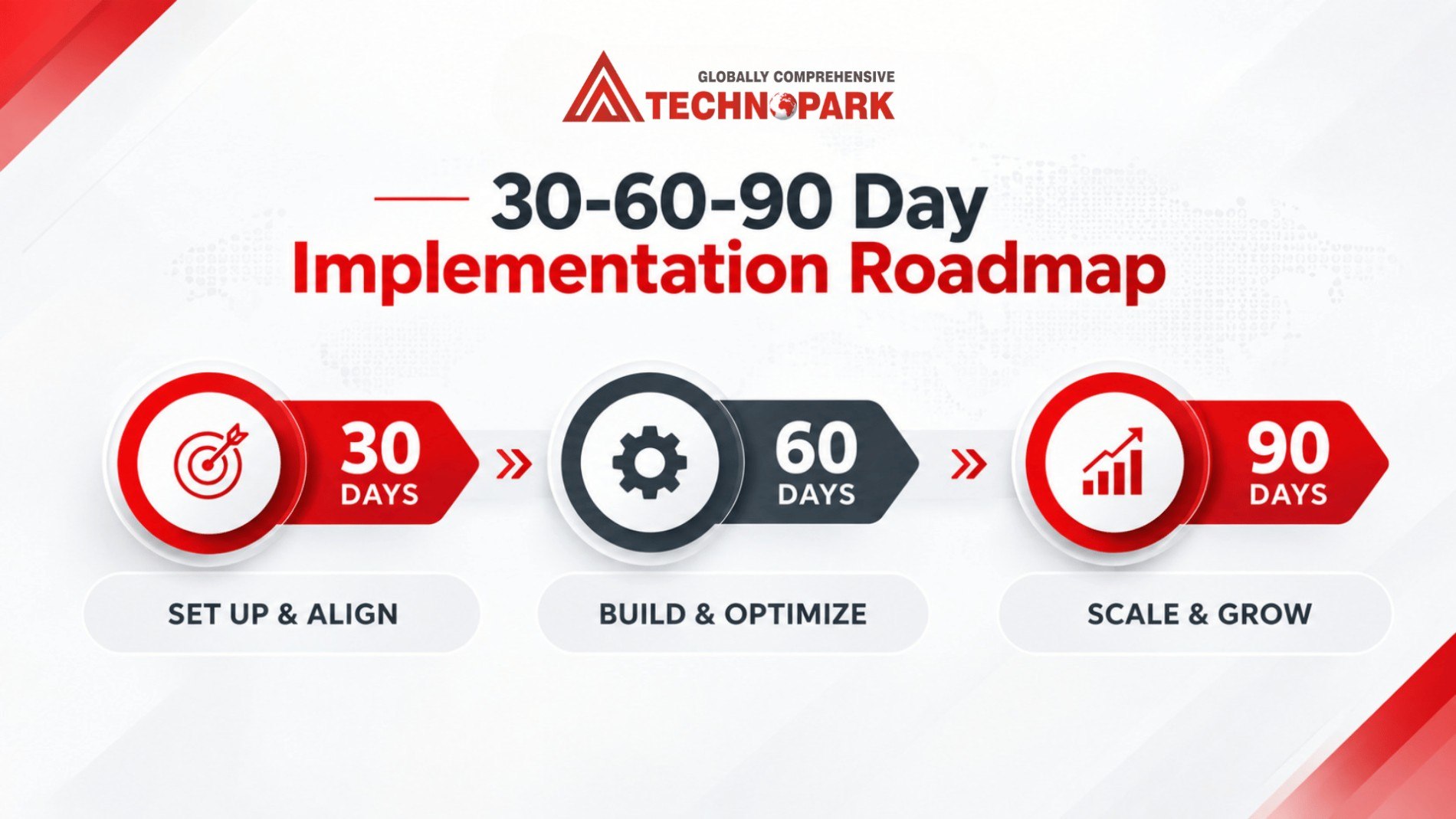
Days 1- 30: Audit and foundation
Using the checklist above, run an audit of your top product and category pages. Configure Google Analytics 4 and Search Console. Fix severe technical SEO concerns (site performance, broken links, mobile usability). Add schema markup to your top-selling product pages.
Days 31- 60: Launch paid, email, and content
Set up your four core email automations. Launch a small retargeting campaign for existing site visitors. Publish two or three buying-guide or comparison articles targeting mid-funnel keywords. Start sponsored listings on your top marketplace if applicable.
Days 61- 90: Optimize and scale
Review the first 60 days of data which channels drove revenue, not just traffic. Begin A/B testing product page elements. Layer in GEO improvements (direct-answer formatting, FAQ schema) on your best-performing content. When you have your core funnel reliably converting, grow into influencer/affiliate partnerships.
Key Takeaways
Digital marketing for e-commerce in 2026 is no longer a checklist of separate tactics it’s a connected system where your product pages, SEO, paid ads, content, email, and marketplace presence all feed the same goal: converting attention into revenue, for both human shoppers and the AI systems now standing between you and them. Start with your foundation (product pages, technical SEO, analytics), layer in paid and content, and build retention in from the start rather than as an afterthought.
FAQs
1. What is the best digital marketing strategy for a new e-commerce store?
Fixing your product pages and core technical SEO first sending paid traffic to a weak page wastes money. Then add retargeting ads and basic email automations.
2. How much should an e-commerce business spend on digital marketing?
Most spend 60-70% on paid promotion to attract customers to their new establishments. Most of these are paid ads. Stores get more benefits as they invest more in SEO, content, and customer retention.
3. Which is better for paid ads or SEO for online stores?
Neither of them do different jobs. Paid ads give fast visibility and test data; SEO builds cheaper, compounding traffic. Most stores need both together.
4. How does AI search (ChatGPT, Gemini) affect e-commerce marketing?
AI shopping assistants may now generate product shortlists directly from organized, consistent content. Good statistics, good FAQs, and good ratings increase the likelihood of getting suggested.
5. What KPIs should e-commerce brands track monthly?
Track five: conversion rate, average order value, customer acquisition cost, repeat purchase rate, and revenue by channel. Enough to guide decisions without drowning in data.