
Growth brings opportunity but also stress to your team. It’s difficult to get skilled people. Big workloads. Customers still want steady, fast service.
Offshore solutions for global businesses can ease that pressure. They provide you with access to talent and operational back-up in another country. But it isn’t just lower costs that drive offshoring. Done well, it protects quality, preserves information security, and enables your team to scale as demand shifts. In this guide, we’ll walk through the major models, the trade-offs involved, and how to decide whether offshoring is right for you.
Why Should Global Businesses Consider Offshore Solutions?
Global businesses should be looking at offshore solutions to ramp up access to skilled talent, add flexible capacity and provide time-zone coverage. Savings may be realized, but not guaranteed. Teams can scale without compromising on quality, with a clear scope, secured processes and a proven partner, offshoring.
In practice, the biggest gains often come from speed and flexibility. A startup can fill a skills gap in weeks. An agency can take on more clients without burning out its team.
What Are Offshore Solutions?
Offshore solutions let you use people, services, or operations in another country. You can open your own overseas unit. Or you can work with a provider that manages the work for you. The work can cover software development, data processing, customer support, administration, and IT staffing. For example, a US software company might hire an offshore team for testing and engineering. Its own leaders still set the product priorities.
People often mix up the related terms. This table clears it up.
| Model | How it works | Best for |
| Offshoring | Work happens in another country | Adding overseas capacity |
| Offshore outsourcing | A provider delivers agreed services from abroad | Handing off defined projects or processes |
| Staff augmentation | External specialists join your team | Keeping direct control of the work |
| Offshore development center | A dedicated overseas team supports ongoing development | Continuous engineering needs |
You can also combine models. Match the structure to the work, not to the term you know best. If you need ongoing engineering capacity, read our guide to an offshore development center.
Types of Offshore Business Solutions
Offshore support covers more than one kind of work. Start by naming the work you need help with.
Software Development and Dedicated Teams
Offshore developers can build websites, apps, and business software. They can also do the testing, cloud setup and maintenance. A dedicated team gives you steady capacity for long-term work. Agree early on roles, reporting, and how the team will work with your staff.
Business Process Outsourcing and Virtual Assistance
You can hand defined tasks to an outside team. Examples include scheduling, CRM updates, inbound support and admin work. This could be used by digital agencies to keep campaign records tidy. Clear instructions lead to consistent output.
Support for data processing and publishing
Some companies need help with data entry, data cleansing, document conversion or xml and typesetting. These are usually high-volume, repetitive jobs. Establish quality standards and review procedures prior to delivery of work.
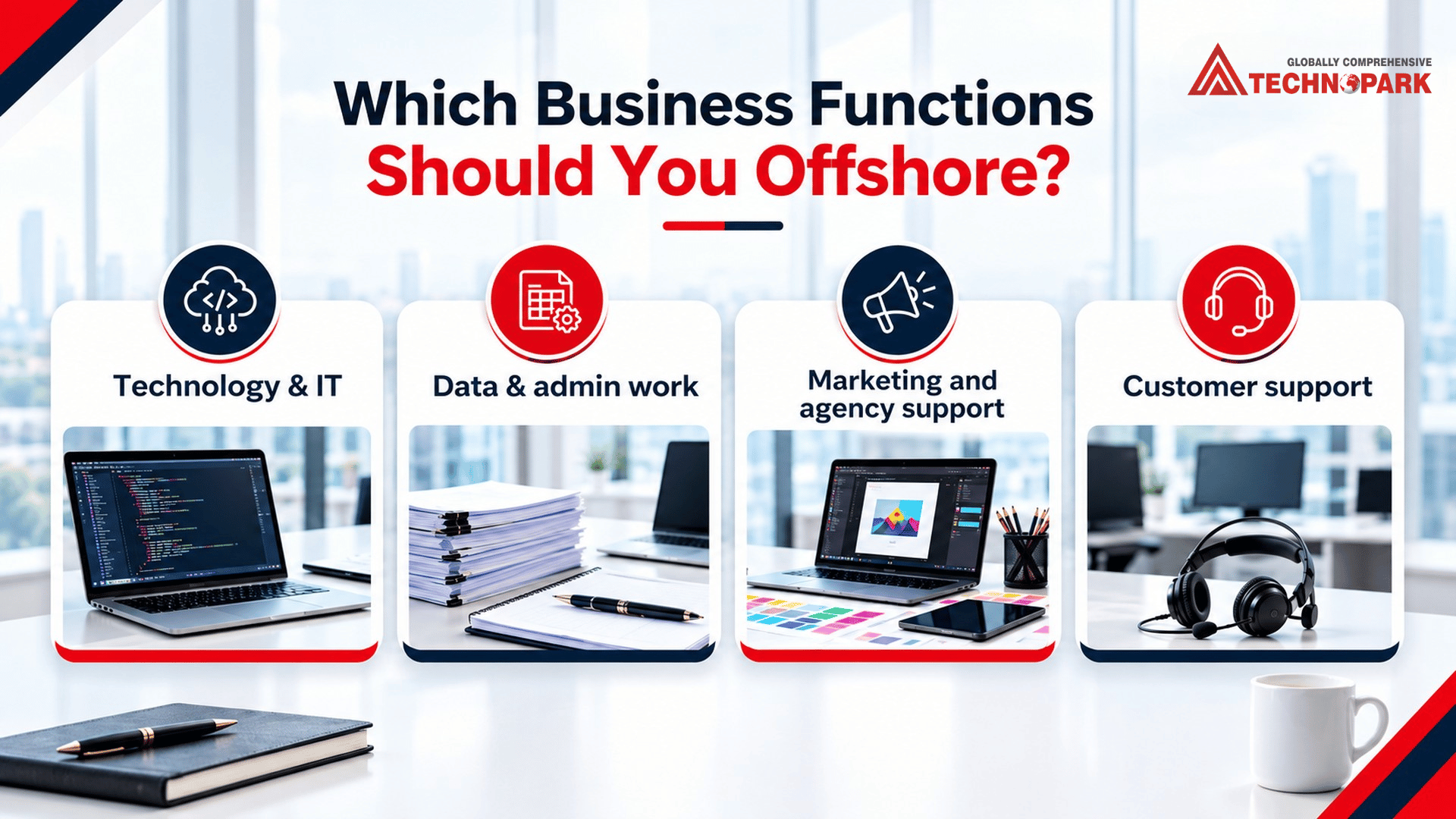
Which Business Functions Should You Offshore?
Great candidates have clear responsibilities and measurable results.
Technology & IT. Development, testing and technical support work well – when the provider has the right skills and security. Define coding standards, access rights, and IP ownership first.
Data & admin work. Validation rules and templates. The offshore team will work on the records, flag exceptions and return the results for review.
Marketing and agency support. Typical use cases are social scheduling, campaign reporting and content operations. General strategy and client relationships are retained in-house.
Customer support. Routine questions and appointment setting can work. Train the team well and set clear escalation paths.
Not everything belongs offshore. When decisions are sensitive, tasks need real-time collaboration, or local regulation is complex, a more granular control may be needed.
Advantages and disadvantages of offshore solutions
Offshoring can add capacity and flexibility. It is contingent upon how well you manage it.
| Potential benefit | Possible challenge | Practical response |
| Access to specialized skills | Finding the right experience | Test skills and review past work |
| Flexible team capacity | Staffing changes | Define scaling and replacement rules |
| Extended working hours | Handover gaps | Agree on overlap hours and documentation |
| Efficient workflows | Inconsistent quality | Set measurable quality standards |
| Outside operational support | Data security concerns | Use access controls and contract safeguards |
Don’t pick a partner on price alone. A cheap rate can cost more if the team misses deadlines or needs heavy rework.
Choosing the Right Offshore Partner
A good partner has a well‐defined process and can demonstrate it works.
Define the scope first.
• List of tasks
• List of the desired output
• Skills required
• Deadline
• Tools used and Next, check relevant experience.
Ask who will do the work, how people are screened, and how performance is reviewed.
Then look hard at security. Confirm how the provider controls access, protects data, handles incidents, and closes out an engagement. Review legal requirements with a qualified adviser where they apply.
Finally, agree on communication. Set reporting schedules, escalation contacts and response times. A short pilot lets you try all of this out before you commit.
How to Establish an Offshore Business Model
Step 1: Define the business problem
See what you need to fix. It could be a skills gap, a growing work load or a backlog. You can’t outsource without a purpose and the problem is clear.
Step 2: Choose the Engagement Model
Pick between a project provider, individual specialists, a dedicated team, or ongoing process support. Decide how much you want to retain control.
Step 3: Write Down Processes and Roles
Develop instructions, templates, quality standards, and access rules. The team can decide on the following items . The following items require approval .
Step 4: Start Small and Measure
Begin with one workflow. Track quality, turnaround, communication, rework Fix scope before you fix issues.
Step 5: Review It Often
“Conduct performance reviews and nip problems in the bud.”That relationship should be viewed as an ongoing process, not a one-time hand-off.
How AI Is Transforming Offshore Operations
AI tools help offshore teams deal with large volumes of work. Document tools can extract fields from forms and invoices. Coding assistants can help developers draft and review code. Analytics tools can flag unusual patterns.
However, AI can be wrong. It doesn’t replace skilled people. Decide where AI helps, how you’ll check its output, and who owns the final result. Protect sensitive data under your company policies.
Common Mistakes to Avoid
Most offshore problems have familiar causes.
- Choosing on price alone. Rework often wipes out the savings.
- Vague scope. Unclear tasks produce unclear results.
- Skipping the pilot. A trial exposes problems cheaply.
- Weak security terms. Put data and IP protection in writing.
- Poor communication habits. Set meetings and shared tools from day one.
How to Measure Offshore Performance and ROI
Measure against a baseline you set before the engagement starts. Pick metrics that fit the work. Track software defects and delivery reliability. Track data work turnaround time and accuracy.It supports and tracks response and resolution time.
The financial return can be estimated by the following formula:
ROI (%) = (Net benefit / total investment) * 100
Fees, onboarding, management time, software, security and rework. Compare similar workloads. And remember that cost cuts alone don’t prove success. Reliable delivery and quality matter too.
Future Trends to Watch
Companies increasingly want skills, not only lower costs. Hybrid combinations of in-house and offshore teams are on the rise. AI is also changing what is done by people and what can be automated. Companies that plan for these changes will be more agile.”
People Also Ask
What are the risks of offshore outsourcing?
Risks include poor communication, data security issues, unclear roles and responsibilities and quality concerns. They are reduced by clear contracts, controls on access and regular audits.
What is the difference between offshore staffing and outsourcing?
Offshore staffing adds professionals to your team under your direction. Outsourcing gives an outside provider responsibility for a defined service or process.
Which services can you offshore?
Typical activities include software development, IT support, data processing, virtual assistance and customer support. The best transfer has clear instructions and measurable results.
How do you start with offshore solutions?
Identify business needs and scope. Select a model, assess vendors and negotiate on security and performance terms. Then run a small pilot.
Choose Offshore Solutions That Support Long-Term Growth
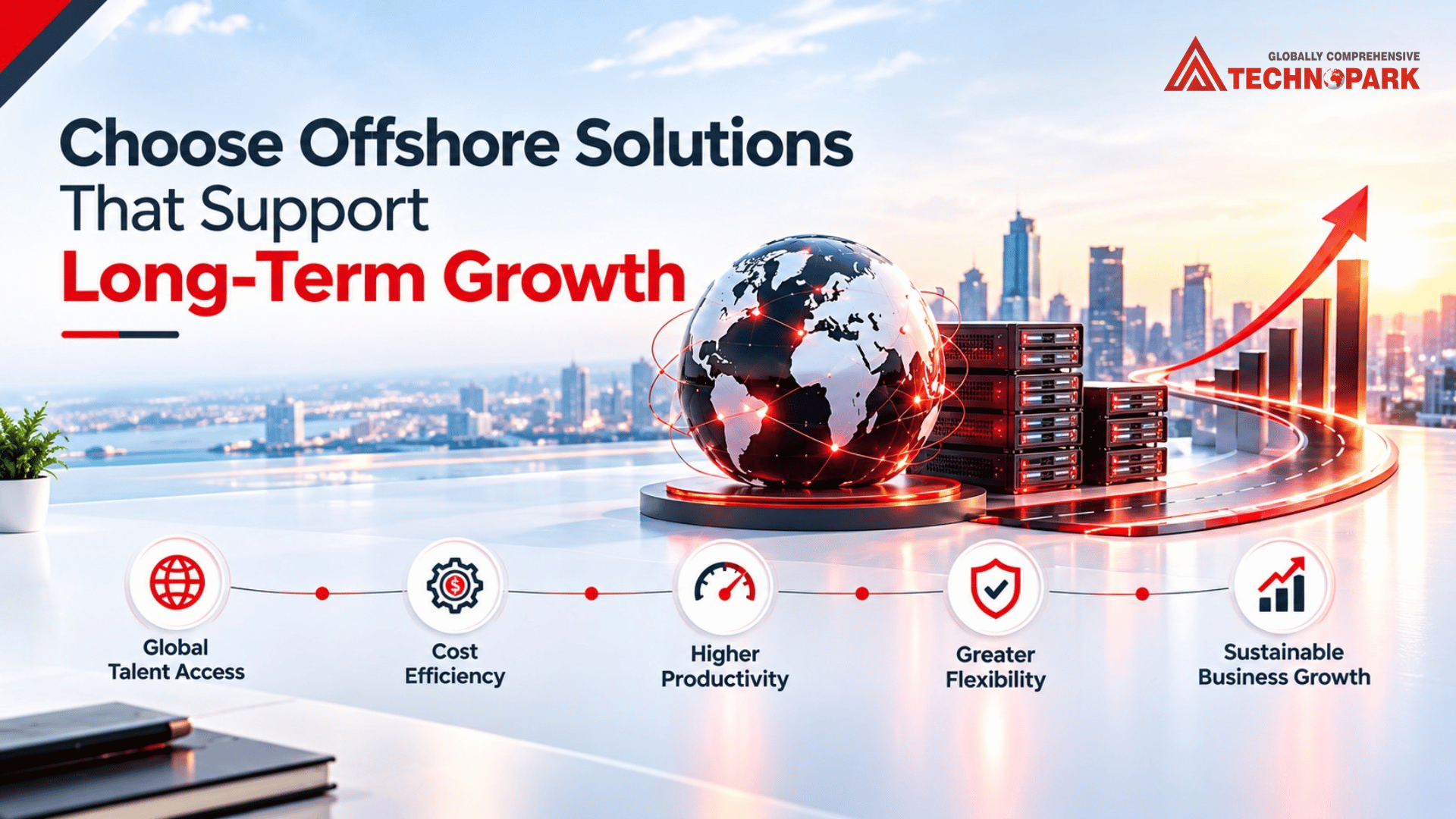
Offshore solutions can help you reach talent, add capacity, and keep operations steady as your needs change. Success comes from the basics: the right model, clear roles, protected data, and steady measurement.
Start with one specific problem. Compare providers based on experience, communication, quality & security. Then test with a small scope before you expand.
Ready to explore your options? See our offshore services and talk to our team about the right approach for your business.
FAQs
1. What’s the offshore solution?
Companies may have global teams doing development, IT support, data processing and virtual assistance.
2. How can offshore solutions help your business to grow?
They provide talented skills, increase capacity and accommodate fluctuating workloads.
3. What can companies do off-shore?
Software development, testing, IT support, data processing, virtual assistant and customer support
4. How do companies handle offshore teams?
Set clear goals, roles defined, communicate often and performance is tracked.
5. How do you measure the offshore ROI
Compare total costs to benefits and track quality, productivity and turn-around time.