

Staff augmentation is the perfect solution if you already have an in-house development team and you require certain talents or capacity. If you have a long-term product, a dedicated development team is usually a preferable option, because you require a solid cross-functional team. How long the project lasts, how much management can handle, how the team is structured, and how much control you need.
Quick Answer
Need extra people? → Staff augmentation can add specific skills or capacity to your existing team.
Building an entire product team? → A dedicated development team can provide the cross-functional roles you need.
Have a defined project to deliver externally? → Project outsourcing can help deliver the project based on a defined scope.
A dedicated development team tends to be the right call when you’re building a long-term product, requirements are still evolving, you need several technical roles working together, and your internal management capacity is limited. Staff augmentation tends to be the right call when you already have a team in place and simply need a particular skill, extra hands for a temporary spike, or direct control over the people doing the work.
What Is a Dedicated Development Team?
What is a dedicated development team? A dedicated development team is a cross-functional team of specialists (developers, QA engineers, designers and sometimes a project manager) dedicated to your product during the engagement. The provider takes care of hiring, HR, and infrastructure, and you’re still in charge of product direction and priorities.
Usually the workflow is the following:
Business or product owner sets the roadmap, dedicated team, development, QA, deployment and improvement. Team composition isn’t fixed; it depends on the product, but a dedicated team can draw on software developers, QA engineers, UI/UX designers, DevOps engineers, business analysts, project managers, and technical leads as needed.
What Is Staff Augmentation?
Staff augmentation adds external professionals into your existing team and workflow, rather than standing up a new team. You get the exact skills or capacity you need, but keep the day-to-day management in-house.
The flow is simple: your existing team identifies a skill or capacity gap, an external developer is brought in, and they work inside your existing workflow through to delivery.
This is most useful when you have short-term capacity needs, a deficiency of a particular skill, an urgent deadline, an imminent product launch, a temporary or one-off project, a requirement for specialized technology or a gap while you recruit permanently.
Key Differences
The key distinction between a dedicated development team and staff augmentation is the team makeup and who manages it. A committed team is a steady team for further development. Staff augmentation is the addition of an expert to the team.
|
Factor |
Dedicated Development Team | Staff Augmentation |
| Team structure | Complete team | Individual specialists |
| Management | Shared/provider-supported | Client-managed |
| Best suited for | Long-term products | Skill or capacity gaps |
| Team continuity | High | Depends on engagement |
| Scalability | Team-level | Role-level |
| Control | High | Very high |
| Internal management | Lower | Higher |
| Knowledge building | Strong team continuity | Integrated into existing team |
| Engagement | Usually longer term | Often flexible |
| Best starting point | New/expanding product capability | Existing development team |
The question isn’t so much “how many developers do you need?” The question is not so much “how many devs do you need? it’s “who should manage the work?”
A dedicated development team makes sense when you’re building a product from scratch and need a full team rather than individual hires, when your roadmap spans months or years, when you need multiple technical skills working together, when internal engineering leadership is limited, when product knowledge and continuity matter, when requirements will keep changing, or when you need a stable team that can scale with the product.
Staff augmentation makes sense when your existing team is already structured and just needs more hands, when you need a specific skill your team lacks, when you have a temporary capacity gap rather than a permanent need, when you need developers quickly without standing up a new team structure, when you want direct day-to-day management, or when your workload changes frequently and you need to flex headcount up or down.
How long does it take to get each model started?
This is one of the most practical questions buyers have, and it’s rarely answered directly. Staff augmentation is built for speed: because you’re slotting a specialist into a workflow that already exists, a vetted developer can typically join an active sprint within one to two weeks of agreeing on requirements. A dedicated development team takes longer to stand up sourcing, vetting, and assembling a cross-functional group, then getting it aligned to your product, typically takes three to six weeks depending on team size and role mix. If you need people producing output almost immediately, that timeline difference alone can be the deciding factor.
Cost Factors
Cost isn’t simply “dedicated team = expensive, staff augmentation = cheaper.” It depends on the total scope of engagement.
Dedicated team costs are shaped by team size, skill level, technology stack, engagement duration, team composition, management structure, and location. Staff augmentation costs are shaped by developer specialization, experience, number of developers, engagement duration, technology, working hours, and replacement requirements.
As a rough guide, offshore staff augmentation in India commonly runs in the range of 15-40 per developer hour depending on seniority and technology, while dedicated offshore teams are typically quoted as a monthly per-head rate that bundles management, infrastructure, and overhead rather than a pure hourly figure. Treat these as directional, not a quote, always confirm current rates directly with a provider, since they vary by skill scarcity, engagement length, and exchange rates.
Which is more cost-efficient depends on the requirement. Staff augmentation can be efficient when you need a few specialists. A dedicated staff can be a cheaper solution if you need ongoing development in several roles because you don’t have to pay for recruitment and onboarding all over again.
Which Model Gives You More Control?
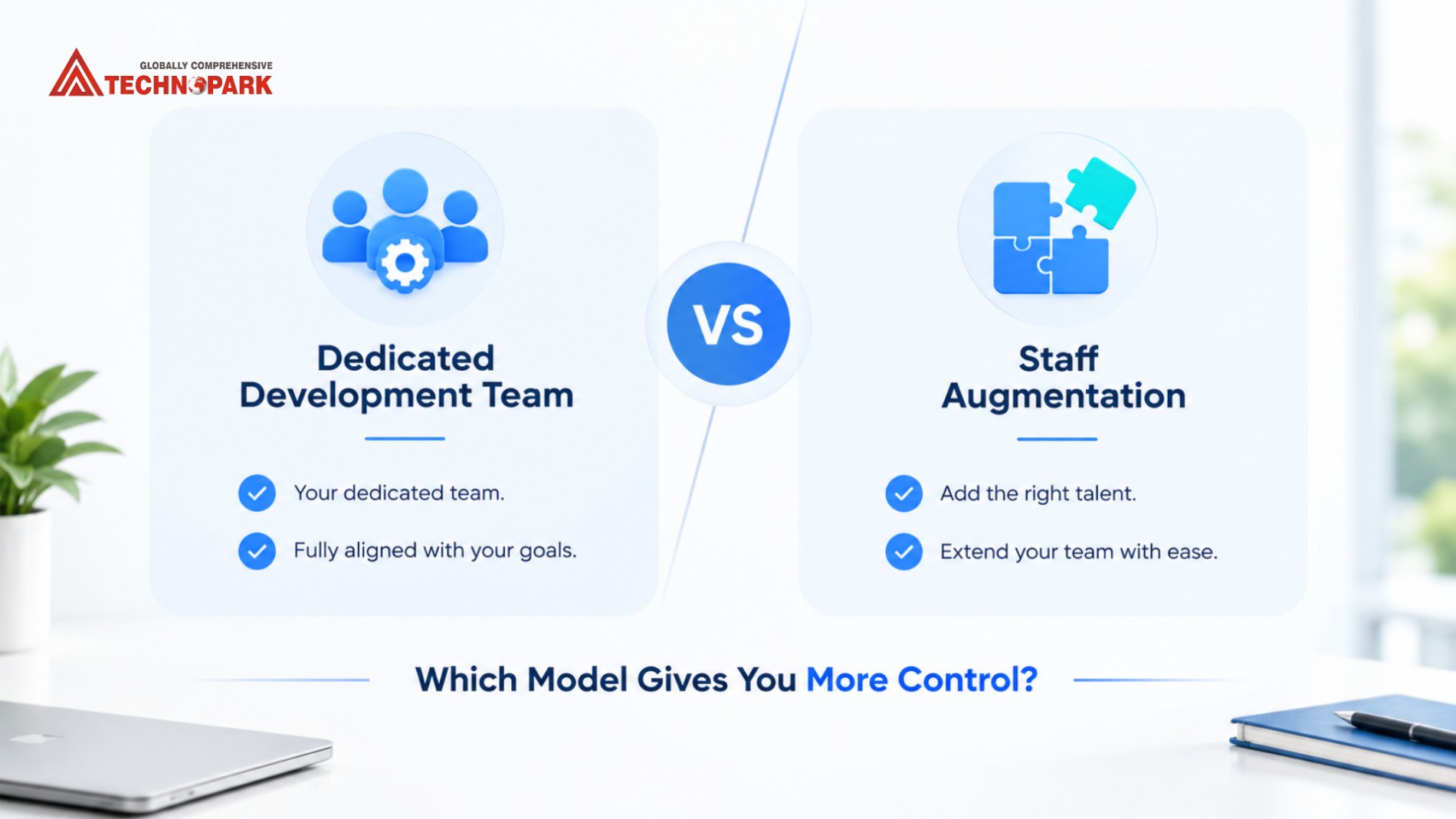
Staff augmentation gives you more direct, day-to-day control you assign tasks, run sprints, and manage code reviews yourself. A dedicated team gives you high product-level control (you still own the roadmap and priorities), but execution responsibility is more distributed across the provider’s team. This difference is more important than “you manage vs. the vendor manages.” Control comes in many forms in job assignment, technical choices, sprint management, code reviews, ownership of the product roadmap and day-to-day communication and each model assigns that responsibility differently.
Which Model Is Better for Long-Term Software Development?
A dedicated development team is generally the better fit for long-term software development. It enables product evolution, knowledge of the domain to be kept within one cohesive team, builds technical ownership and scales more naturally with a multi-year roadmap.
Which Model Is Better for Short-Term Development Needs?
Staff augmentation is usually best for short term needs. It’s well suited to temporary workload spikes, specialist requirements, product launches, tight deadlines, migrations, testing pushes, and filling specific technical gaps without a long-term commitment.
Contracts, IP, and Data Ownership
Most comparison articles skip this entirely, but it’s usually the first thing a legal or procurement team asks about. In both models, intellectual property produced during the engagement is normally assigned to the client through the Master Service Agreement (MSA) and Statement of Work (SOW) but how that’s structured differs. With staff augmentation, IP assignment is typically straightforward because the augmented developer is working inside your own repositories and tools under your existing agreements. With a dedicated team, IP terms need to be explicit in the contract, since the provider is managing infrastructure and access on your behalf; make sure the SOW states clearly that all code, documentation, and deliverables are your property, not the provider’s, and that this survives termination of the contract.
NDAs should be signed before any technical discovery begins, and it’s worth confirming, in writing, what access (repositories, credentials, client systems) is revoked and when the engagement ends this is a common gap that only surfaces when a relationship ends badly.
Security and Compliance for Offshore Engagements
If your product touches regulated data, healthcare records, financial information, personal data under GDPR this deserves its own conversation with any provider, and it’s an area none of the major comparison articles address. Ask how each model handles data access controls, whether developers work in your environment or the provider’s, what compliance certifications the provider holds (ISO 27001, SOC 2, or industry-specific standards like HIPAA-aligned practices for healthcare clients), and how background checks and confidentiality are handled for individual developers. Staff augmentation generally simplifies this, since the added developer works inside your existing security perimeter. Dedicated teams require more explicit agreement on where code and data live, who can access production systems, and how the provider’s own infrastructure is secured.
Timezone and Communication in Offshore Engagements
Beyond cost, the practical friction in any offshore engagement comes down to overlap hours and communication habits. Before starting either model, clarify how many working hours overlap with your team’s day, what tools are used for standups and async updates, and who owns escalation if something blocks progress outside overlap hours. Staff augmentation tends to need tighter overlap, since augmented developers plug directly into your existing meetings and workflows. With a dedicated team, you do not need to overlap as much on a day-to-day basis as the provider normally handles the internal coordination and syncs with you at pre-determined milestones rather than every stand-up.
Advantages and disadvantages
A dedicated development team offers you strong continuity, cross-functional capability, long-term product knowledge, easier scaling at the team level and a reduced recruitment burden. The trade-off is that it requires a longer-term commitment, can be excessive for a small temporary requirement, and needs clear product direction to work well.
Staff augmentation offers flexible team size, fast access to skills, direct management, and an easy way to add specific specialists for temporary needs. The trade-off is greater internal management responsibility, onboarding effort, coordination that can grow as the augmented team expands, and less suitability when you need a fully autonomous team.
What to Look for in a Provider
Choosing between the two models only matters if you’re also choosing the right provider, something most comparison content skips entirely, as if the vendor were interchangeable. For either model, look at the provider’s track record with your specific technology stack, not just general development experience. Ask how developers are vetted technically, what happens if someone needs to be replaced mid-engagement, and how much timezone overlap they can realistically offer your team. For a dedicated team specifically, ask who manages day-to-day coordination and how product knowledge is retained if a team member leaves. For staff augmentation, ask how quickly a replacement can be sourced if a developer is unavailable, since continuity risk sits more with you in this model.
Common Mistakes When Choosing Between the Two
The most common mistake is choosing staff augmentation without the internal leadership to manage the added developers, or the reverse building a dedicated team for a project that’s really too short to justify one. Comparing only hourly rates instead of total cost of engagement is another frequent trap, as is ignoring team continuity when the product will need long-term support. Rounding it out: failing to clearly define roles and responsibilities up front, and choosing a model based on team size alone rather than management fit and timeline.
Can You Combine Staff Augmentation and a Dedicated Team?
Yes. The choice isn’t always binary. A company may run a dedicated team for its core product while adding an augmented specialist, a security engineer or DevOps expert, for example for a temporary need. In this hybrid model, the core dedicated team carries the product forward while staff augmentation fills in specialized skills or temporary capacity on top of it.
Switching Models Mid-Engagement
It’s common to start with staff augmentation to plug an immediate gap, then transition to a dedicated team as the product’s scope grows or occasionally the reverse, scaling down from a dedicated team to a smaller augmented presence once a product stabilizes. Before you start, check that your contract allows this kind of transition without penalty, that knowledge transfer responsibilities are spelled out (who documents what the augmented developer built, for instance), and that there’s a clear handoff process for access, credentials, and outstanding work if you change providers or models. Planning the exit before you need it avoids the scramble that usually happens when a transition is handled reactively.
Dedicated Team vs Staff Augmentation vs Project Outsourcing
A third option worth knowing about: project outsourcing, where a provider delivers a defined outcome rather than providing people or a team.
| Model | Best For | Management | Scope |
| Staff Augmentation | Skill/capacity gaps | Client | Flexible |
| Dedicated Team | Long-term products | Shared | Flexible |
| Project Outsourcing | Defined outcomes | Provider | Defined |
This distinction matters because “I need developers” is a different problem than “I need someone to deliver the entire project.”
How to Choose the Right Development Model
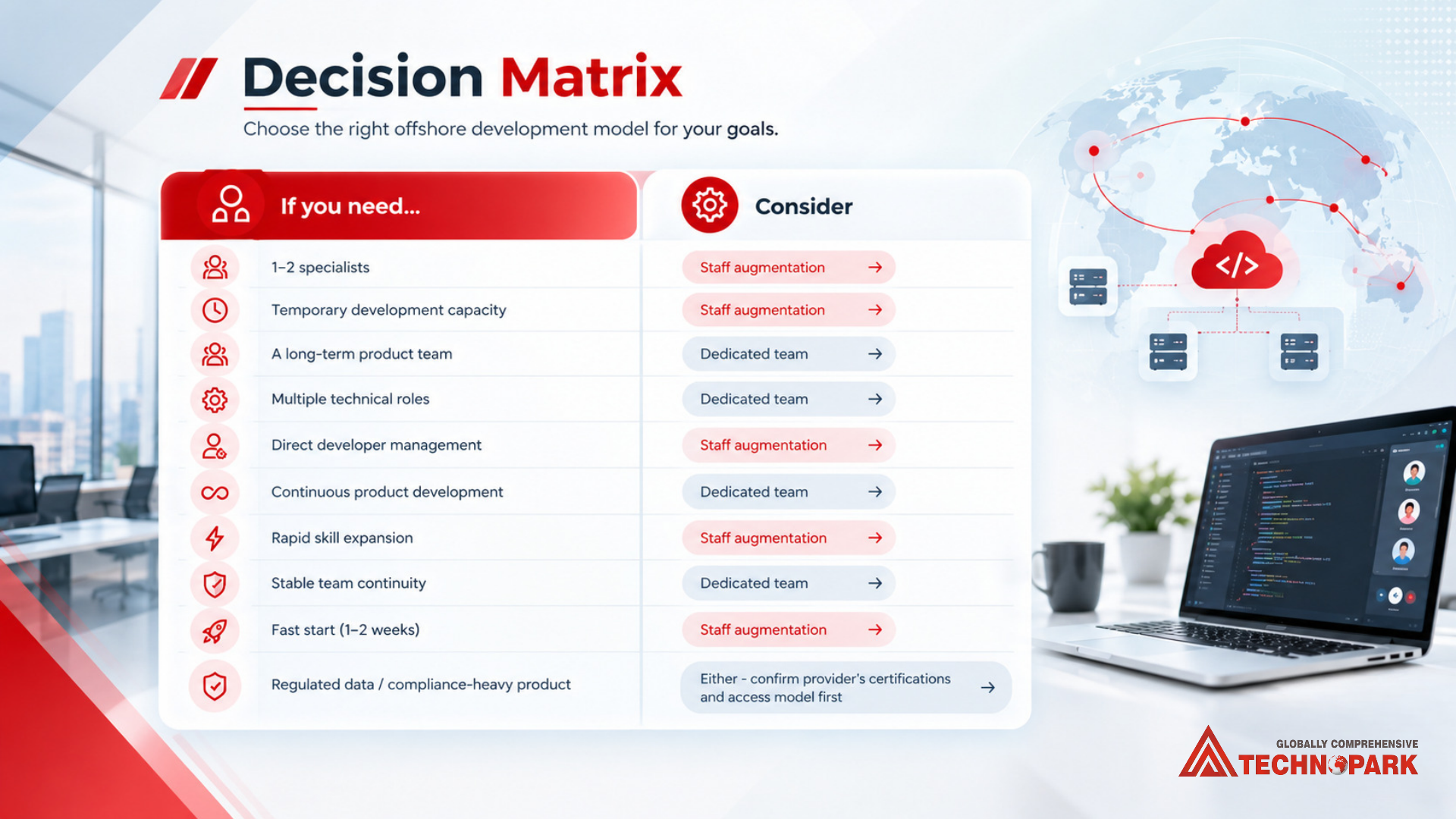
Start by asking whether you already have a technical team in place if yes, staff augmentation may fit; if no, a dedicated team may fit better. Next, consider whether you need just one or two specific skills, which again points toward staff augmentation, or whether the product is expected to evolve over months or years, which points toward a dedicated team. Then weigh your internal management capacity: if you have managers available, staff augmentation can work well; if not, a dedicated team can reduce that burden. Finally, ask whether you need a complete cross-functional team if so, a dedicated team is the clearer fit.
Which Should You Use?
Start with the real question: who should manage the work? If you need people to slot into a team you already run, staff augmentation gets you there fastest. If you need a stable, cross-functional team to carry a product forward over the long run, a dedicated development team is the better fit and the two models aren’t mutually exclusive. Whichever you choose, the model matters less than the provider: confirm timelines, IP terms, security practices, and vendor track record before you sign anything.
Not sure which development model fits your project? Discuss your requirements with AAA Techno Park’s technology team and evaluate the right team structure, skills, and engagement model for your project.
FAQs
1. What’s the main difference between the two models
Dedicated team owns delivery; augmentation doesn’t.
2. Which model costs less overall?
Depends on project length and scope.
3. Can I switch models partway through a project?
Yes, a lot of teams do transition slowly over time.
4. Who owns the code and IP?
This should always be defined in contract terms.
5. Which model suits an early-stage start-up best?
Depends on internal technical leadership strength.
6. How long until a dedicated team is productive?
Typically two to four weeks onboarding.