

Choosing an Offshore Development Partner is much more than hiring professionals at a reduced hourly rate. The proper partner gives you access to experienced personnel, reliable delivery, straightforward communication, secure development methods and the option to scale your team as your organization grows.
In 2026, companies have more offshore options than ever which also makes the choice harder. Two providers can look nearly identical on paper, offering similar technologies at similar prices, while delivering very different levels of technical depth, project ownership, security discipline, and long-term support.
What Is an Offshore Development Partner Today?
An Offshore Development Partner is a company based in another country that provides software development resources, technical expertise, infrastructure, and project support. The relationship can look like anything from a single project engagement to a dedicated team that functions as a genuine extension of your internal team.
Unlike hiring individual freelancers, a proper offshore partnership can hand you a complete development structure. Depending on the model, the provider might take care of recruitment, infrastructure, HR, payroll, quality assurance, and day-to-day team operations, while you stay focused on product requirements and priorities.
Offshore Partner vs Other Models
Offshore development, outsourcing, staff augmentation, and nearshoring get used almost interchangeably in casual conversation, but they actually describe fairly different working arrangements.
| Model | How It Works | Best For |
| Offshore Development Partner | Long-term technical team or development relationship in another country | Businesses building or scaling products |
| Outsourcing Partner | External company delivers defined services or projects | Businesses with specific project requirements |
| Staff Augmentation | External developers join an existing internal team | Filling temporary skill or capacity gaps |
| Nearshoring | Team operates from a geographically closer country | Businesses needing greater time-zone overlap |
Which model actually fits you comes down to how much control you want to keep, how long the project will run, what skills you need, your budget, and how much internal bandwidth you have to manage the relationship day to day.
Why Businesses Choose Offshore Development Partners
Cost is usually what gets companies looking at offshore development in the first place, but it’s rarely the only reason they stay. A well-managed offshore team can also open the door to specialized talent and extra technical capacity without you having to build every operational function in-house.
Cost Efficiency
Offshore development tends to reduce costs simply because engineering salaries and operating expenses differ from one country to another. That said, comparing hourly rates alone can be misleading. A lower rate doesn’t automatically mean a lower total cost once you factor in recruitment, infrastructure, project management, turnover, quality assurance, training, and communication overhead.
To put a number on it, current market estimates for Indian software development vary quite a bit depending on seniority, technology, and engagement model. One 2026 market guide places senior Indian offshore development rates around $35–$75 per hour. Therefore, AAA Techno Park states that its offshore development center model can deliver meaningful cost savings compared with Tier-1 locations.
Access to Specialized Talent
Local hiring markets don’t always have enough developers with deep experience in areas like AI/ML, cloud infrastructure, mobile development, cybersecurity, or niche frameworks. Working with an offshore software development company opens up a much wider talent pool, without you having to stand up a local recruitment operation just to find the right people.
Faster Team Expansion
Building out a full technical team locally can take a long time. An established offshore partner has usually already solved the recruitment, technical screening, infrastructure, and onboarding problem which makes it a lot easier to add developers, QA engineers, or DevOps specialists as your project requirements shift.
Flexible Development Capacity
Your development rarely stays flat throughout the year; you might need extra hands around a product launch and fewer resources once the dust settles. A flexible offshore services model lets your team size and skill mix move with the business instead of staying locked in place.
More Focus on Core Business
Recruitment, payroll, infrastructure, equipment, and general employee administration all eat into time that could go toward the product itself. With a managed offshore model, the provider absorbs a lot of that operational load, freeing your internal team to focus on strategy, customers, and growth.
Types of Offshore Development Engagement Models
There’s no single “right” way to work with an offshore provider. The best model depends on how much control you need and how clearly you can define the scope of work.Control
| Model | Cost Structure | Control | Suitable For |
| Fixed Price | Agreed project price | Moderate | Clearly defined projects |
| Dedicated Team | Monthly/team-based | High | Long-term product development |
| Staff Augmentation | Hourly or monthly | High | Expanding an existing team |
| Build-Operate-Transfer | Development followed by transition | Very High | Businesses planning a future internal team |
Fixed-Price Development
A fixed-price model works best when the scope, deliverables, timeline, and acceptance criteria are all clearly nailed down in advance. It gives you predictable budgeting, but any changes to the original scope will usually mean additional discussions and often additional cost.
Dedicated Development Team
A dedicated team works continuously on your product, and you generally get more say over who’s on the team, what they prioritize, how they work, and how communication flows. This model tends to suit startups and established businesses alike when the need is ongoing development rather than a single, bounded project.
Staff Augmentation
Staff augmentation lets you plug specific skills into your existing team, say, two React developers, a QA engineer, or a DevOps specialist without hiring for those roles internally. Your organization typically holds onto more of the day-to-day project management here than with other models.
Build-Operate-Transfer
A Build-Operate-Transfer arrangement means the offshore team is built and run by the provider first, with the plan to eventually hand the team or the operation over to you. It’s a useful path for businesses that want an international development presence but aren’t ready to set up the entire operation themselves right away.
How to Verify an Offshore Development Partner
Before you sign anything, make sure the provider is actually an established business with the people, processes, and infrastructure your project needs.
Company & legal information check
Begin with the basics: company registered name, years in business, physical location, website and management information. Verify consistency across official records, LinkedIn, company website and other places. Mismatches or gaps here are worth asking about directly.
Verify the Development Team
Don’t stop at the sales team. Ask to actually meet the developers, technical leads, and project managers who would work on your project, and look into their real technical backgrounds, specifically how much hands-on experience they have with your technology stack.
Review Security Practices
How closely you scrutinize security should match the sensitivity of what the team will have access to. ISO/IEC 27001 is an international standard for information security management, and it provides a solid framework for managing security risk but you should actually verify a provider’s certification rather than assume every company you talk to follows it. Ask directly about access controls, password policies, source-code security, backups, employee access, device security, and how incidents get handled.
Speak With Previous Clients
A conversation with a past client will tell you things a sales deck never will. Ask about communication, technical quality, delivery consistency, responsiveness, how stable the staff has been, and maybe most usefully how the provider handled things when something went wrong.
Request a Live Team Introduction
A video call with the actual team gives you a real sense of how the provider works day to day. Ask them to walk you through a previous project, their development process, how they approach testing, how the team communicates internally, and how they’ve handled technical challenges in the past.
How to Choose the Right Offshore Development Team
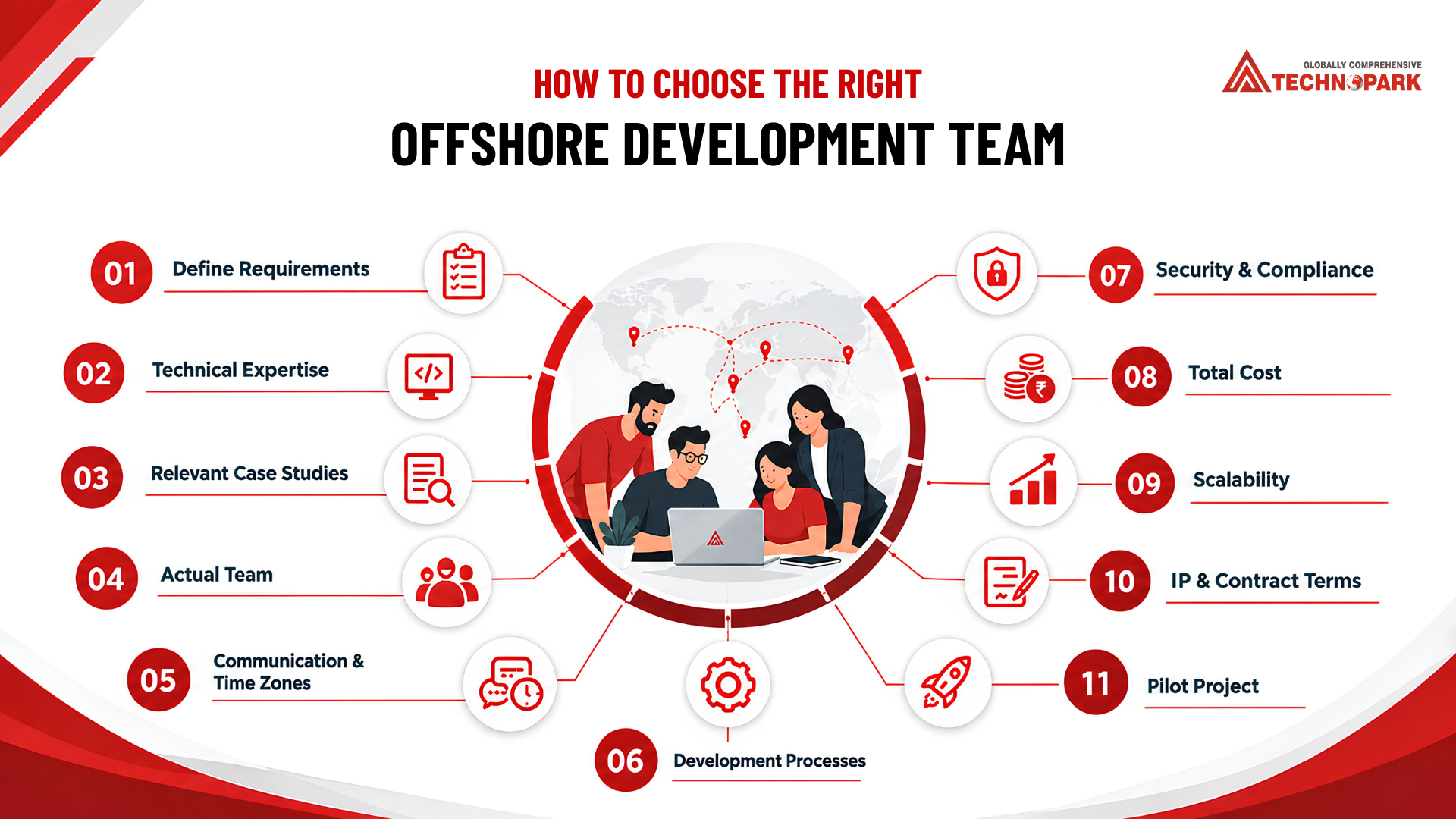
Once you’ve verified a shortlist of providers, run them all through the same evaluation process so you’re comparing like for like.
1. Define Your Requirements
Start by writing down what you actually need: the type of product, the tech stack, roughly how big a team you’ll need, how long the project will run, what stage the product is at, the skills required, working-hour expectations, communication preferences, and your budget range.
It also helps to define success in measurable terms. Rather than aiming for “a good application,” pin down specifics like release frequency, performance targets, testing coverage, or delivery milestones you can actually check against.
2. Evaluate Technical Expertise
Make sure that the provider really has experience in the technologies that your project requires. A business may be great at broad software development but may have little experience with your specific cloud platform, mobile framework, database architecture or AI requirements thus asking real technical questions while evaluating them rather than taking service site claims at face value.
3. Review Relevant Case Studies
Look for projects that actually resemble yours in technology, industry, complexity, and business objective. A portfolio with dozens of projects isn’t worth much if none of them are close to what you’re building.
4. Check the Actual Team
Find out exactly who would work on your project and how that team would be structured whether developers are full-time employees, contractors, shared across clients, or fully dedicated to you. And ask, directly, what happens if a key developer leaves partway through.
5. Assess Communication and Time Zones
Time-zone differences on their own rarely break a project poor communication processes do. Before development starts, agree on overlapping working hours, how often you’ll meet, what response times to expect, how reporting will work, which project management tools you’ll use, and what the escalation path looks like when something needs urgent attention.
6. Review of Development Processes
Learn how the team handles requirements, development, testing, code review, deployment, documentation and change requests. A solid offshore partner should be able to walk you through this clearly, rather than simply promising fast delivery and leaving the details vague.
7. Evaluate Security and Compliance
Security needs a real conversation before the team gets access to your systems or data.
Data Protection
Work out exactly what information the team will touch, and where that information will be stored or processed.
Access Control
Push for role-based access wherever it’s practical developers should get access based on their actual responsibilities, not blanket access to everything.
Source Code Security
Get clear on where your source code lives, who can reach the repositories, how credentials are managed, and how access gets revoked once someone rotates off the project.
Confidentiality
Your NDA and confidentiality terms should explicitly cover source code, business information, customer data, documentation, and anything else sensitive.
Industry Requirements
If you’re working with healthcare data, financial information, or other regulated categories, pin down exactly what’s required before you choose a provider. Don’t assume a generic “we’re compliant” statement actually covers your specific situation.
Security isn’t a box-ticking exercise either; the stakes keep rising. IBM reported that the average organizational cost of a data breach in India reached INR 255 million in 2026.
8. Compare Total Cost
Look at the complete cost picture, not only the developer rate salary or service fees, infrastructure, management, recruitment, onboarding, QA, software licenses, communication overhead and the cost of replacing individuals if needed.
9. Check Scalability
Ask how quickly the partner can add or swap out resources. If your team needs to go from five developers to fifteen, you want to know upfront whether they actually have the talent and infrastructure to make that happen, rather than finding out the hard way.
10. Review IP and Contract Terms
The agreement should be explicit about intellectual property ownership, confidentiality, payment terms, warranties, responsibilities, termination, data handling, and knowledge transfer. IP ownership in particular should never be left to assumption.
11. Consider a Pilot
A small pilot project can tell you a lot in a short amount of time how the provider communicates, how they estimate work, how they handle feedback, how they document tasks, and how they manage deadlines. It won’t eliminate all risk, but it gives you real, practical evidence before you commit to something bigger.
Questions to Ask an Offshore Development Partner
Before signing, ask the kinds of questions that reveal how the relationship will actually run once the sales process is over.
On technical expertise, ask which technologies and similar projects they’ve genuinely handled. The team structure, find out who would actually work on your project and whether they’d be dedicated to you. On communication, inquire what channels, meetings and response times you should expect. Ask them particularly about how they protect source code, credentials, client data and company information.
Pricing: Get clear about what is included in the quote and what could lead to additional charges. Ask them how fast they can add more developers or specialists in terms of scalability. And ask about what happens when development is done or after the first release, when you are in support. Ask, on replacement, what happens if a developer leaves the project mid-stream. On IP ownership, ask who actually owns the source code and other deliverables. And on exit, ask how knowledge, documentation, source code, and access would be transferred if the partnership ends.
The quality of the answers matters just as much as the answers themselves. A reliable provider should be comfortable discussing the uncomfortable stuff, like security gaps, replacement plans, pricing edge cases, and termination.
Red Flags to Watch in Offshore Development Partners
No single warning sign automatically disqualifies a provider, but a few of these showing up together is worth pausing over.
Be cautious of unusually low pricing that isn’t clearly explained; a rate well below the rest of the market may reflect real differences in seniority, quality control, management overhead, infrastructure, or scope, rather than simply being a good deal. Vague technical experience is another one to watch for: if a provider claims expertise in everything but can’t point to relevant projects or introduce you to qualified technical staff, push for more evidence before moving forward.
Steer clear of arrangements where you have no real visibility into who’s doing the work you should always know who’s assigned to your project and how that team is managed. Unclear IP ownership deserves the same scrutiny; your agreement needs to spell out ownership and access to the code and deliverables in plain terms.
Security should be something the provider can actually explain, not just assert. If they can’t walk you through how they manage access, credentials, devices, repositories, backups, and sensitive information, that’s a reason to dig deeper before granting them anything. And finally, be wary of unrealistic promises. A credible IT outsourcing partner should be upfront about assumptions, dependencies, risks, and limitations, rather than assuring you that everything will simply get done, fast, no caveats.
How to Build a Long-Term Offshore Partnership
Finding the right provider is really just step one. Making the relationship actually work long-term comes down to how clearly responsibilities are defined on both sides.
Start by deciding who owns product decisions, technical decisions, project management, approvals, and communication and make sure that’s understood by everyone, not just assumed. Build a regular communication rhythm around it: depending on the project, that might mean daily check-ins, weekly progress reviews, sprint planning, demos, and monthly performance conversations.
Documentation matters just as much. Requirements, architecture decisions, coding standards, deployment procedures, credentials, and operational knowledge shouldn’t live only in one developer’s head and knowledge transfer works best as an ongoing habit rather than something that only happens when someone’s about to leave. That habit alone makes replacement and scaling far less disruptive when the time comes.
Finally, revisit the partnership on a regular schedule rather than only when something breaks. Look at delivery, quality, communication, team stability, security, and actual business outcomes, not just whether the last sprint went smoothly.
How to Measure Offshore Team Performance Effectively
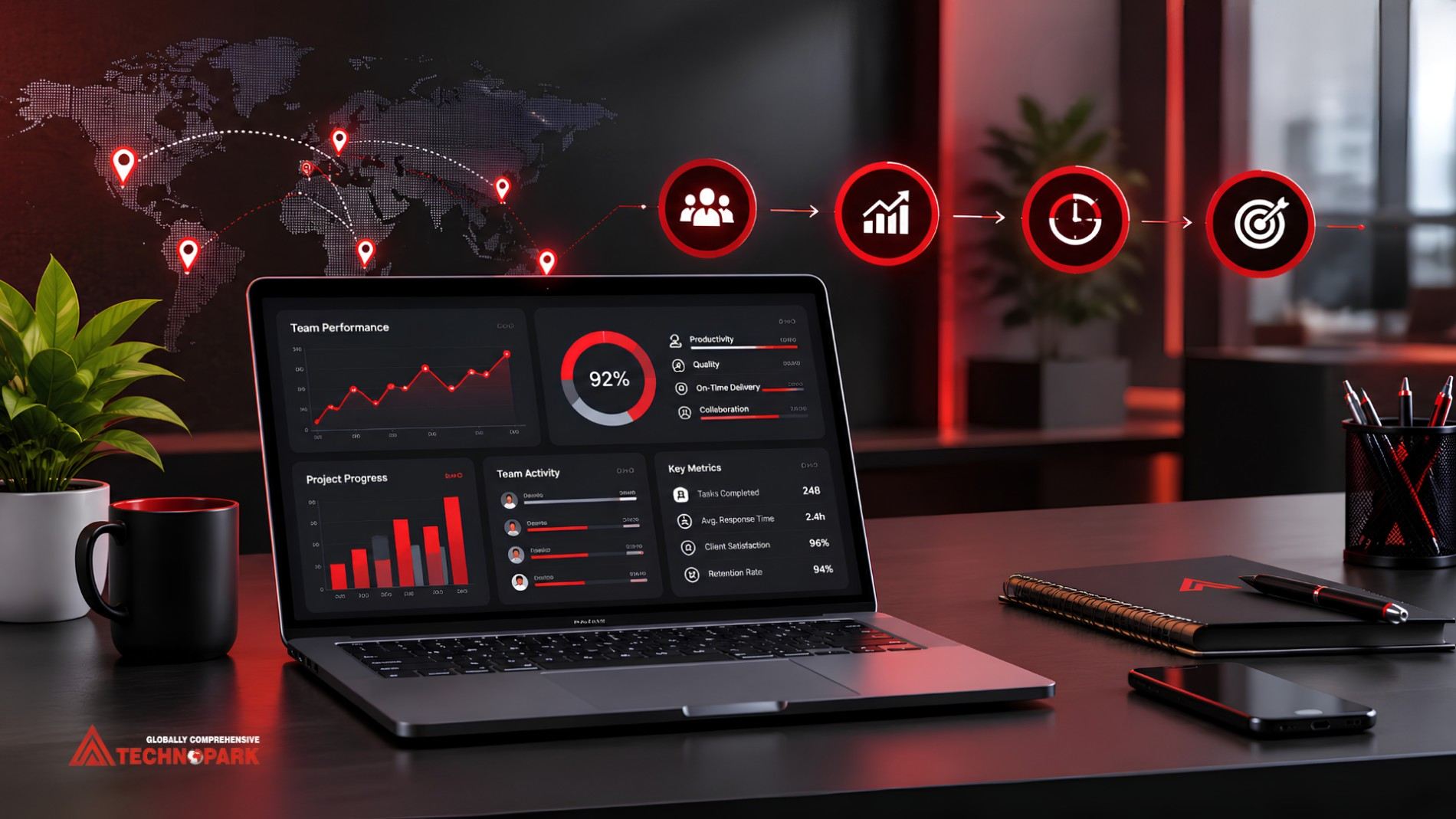
A good offshore development team should be judged by meaningful outcomes, not by how many hours show up on a timesheet.
Delivery can be tracked through sprint completion, milestone achievement, release frequency, and how consistently agreed timelines are actually hit. Quality is reflected in defects and rework, failed releases, test coverage and stuff that gets into production. Communication is measurable too: response times, how quickly issues get resolved, documentation quality, and whether reporting commitments are actually kept.
Team continuity is worth watching closely, since frequent developer turnover quietly erodes both product knowledge and delivery consistency. And for larger engagements, it’s worth tying performance back to real business outcomes faster releases, better application performance, lower operational costs, a better customer experience, or more development capacity overall.
The right KPIs will always depend on the project. A startup shipping an MVP shouldn’t be measuring itself the same way an enterprise maintaining a large production platform does.
Offshore Development Partner Selection Checklist
Before signing, run your shortlisted providers through this list:
- Relevant technical expertise
- Similar project experience
- Verified developer profiles
- Clear team structure
- Communication and time-zone plan
- Defined security practices
- Appropriate compliance requirements
- Transparent pricing
- Suitable engagement model
- Scalability options
- IP ownership terms
- Confidentiality provisions
- Support and maintenance
- Knowledge-transfer process
- Developer replacement process
- Termination and exit terms
- Pilot or trial opportunity
This list does not help you find a provider who says “yes” to everything; it ensures you answer your important questions before you commit.
Why Choose India for Offshore Development Teams?
India remains one of the major destinations for offshore software development. Largely it thanks to its large technology workforce, its established IT services industry, and the sheer range of technical capabilities on offer. Businesses can find developers across web development, mobile applications, cloud infrastructure, QA, DevOps, AI, and machine learning and we can support everything from a single technical resource to a full offshore development center.
That said, location shouldn’t be the deciding factor on its own. A provider’s technical capability, communication practices, security controls, team stability, and genuine understanding of your business matter just as much arguably more. So for businesses considering India, the real evaluation should focus on the specific partner rather than treating the whole country as one uniform market.
How AAA Techno Park Supports Offshore Development
AAA Techno Park provides managed offshore development services from India, including dedicated development teams and full offshore development center support. Its offshore development center model covers recruitment, developer screening, infrastructure setup, HR, payroll, day-to-day operations, quality assurance, and team scaling while clients still take part in developer selection instead of handing that over entirely.
The company supports software development across web and mobile technologies. Along with the QA and testing, cloud and DevOps, and AI/ML capabilities. Therefore, AAA Techno Park states that its offshore development center teams can typically be stood up within about 2- 4 weeks, depending on requirements, and its current company information lists ISO 9001:2015 certification, 130+ operational seats, and support for dedicated, project-based, and hybrid engagement models.
For businesses weighing an offshore development partner in India, the practical upside of this model is straightforward: you stay focused on product direction while the provider handles much of the operational work involved in building and running the team.
Choosing an Offshore Partner
Choosing an offshore development partner shouldn’t come down to price alone. A proper evaluation looks at technical expertise, team quality, communication, security, scalability, contract terms, IP ownership, and long-term support, all together.
Start by getting clear on what your business actually needs. Then, compare vendors on the same criteria, verify their claims rather than taking them at face value, talk to the actual development team, and consider a controlled pilot before making a bigger commitment.
If you are a company looking at India, an offshore development center can give you access to strong technical talent, and an experienced provider will handle recruitment, infrastructure, HR and day-to-day operations on your behalf.
AAA Techno Park assists companies who want to build dedicated offshore teams in India for recruitment, infrastructure, operations, software development, QA, cloud and DevOps, AI/ML and more. If you’re planning to build or expand an offshore development team, you can explore AAA Techno Park’s Offshore Development Center services or talk to its team directly about your requirements.
FAQs About Offshore Partners
1. What is an offshore development partner?
Work from home. An extension to your own team providing infrastructure, QA, technical support and developers.
2. How do I verify an offshore development partner?
Before you sign the contracts, read through the contracts, client references, security standards, developer profiles, company information and technical know-how.
3. What does an offshore team cost?
Depends on location, seniority, tech stack and engagement model.Don’t just look at the hourly rate. Look at the total cost.
4. Who owns software built by an offshore team?
From the beginning of the deal, ownership of the code, documentation and deliverables must be clear.
5. How do offshore teams keep data secure?
Your data is safe with us: NDAs, secure storage, access control and compliance.