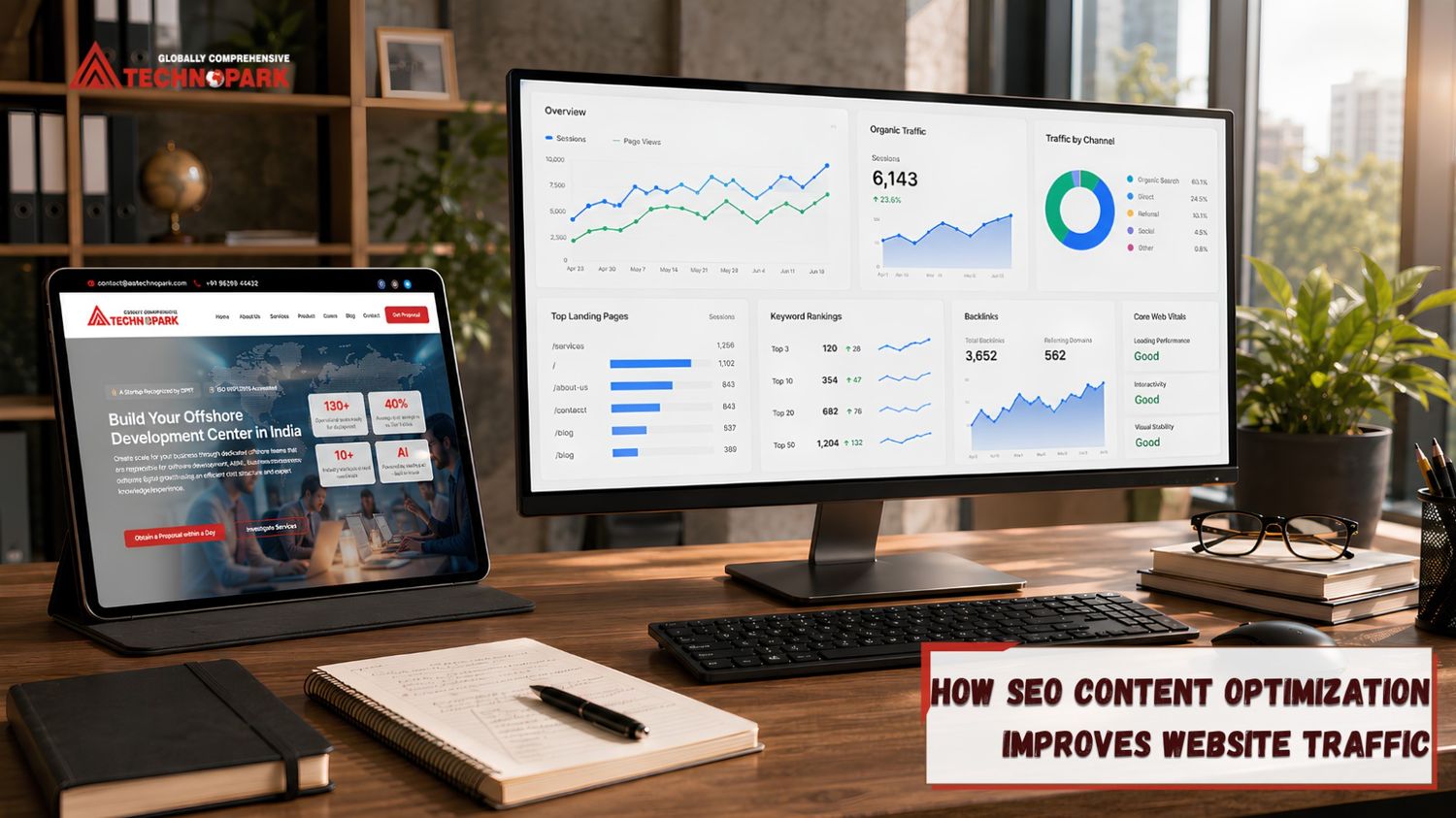
Every business with a website is competing for the same limited real estate: the first page of search results. Content optimization is what determines whether your pages show up there or get buried on page five, where almost no one ever looks. At its core, SEO content optimization is the practice of shaping what you publish and how you publish it so that both search engines and human readers find it relevant, useful, and trustworthy.
Optimized content has a direct and measurable impact on your organic traffic. It ranks better when the content is built around real search intent, employs the relevant keywords naturally and provides real value. Higher rankings mean more visibility, more clicks and ultimately more of the right visitors landing on your site – people who are actually looking for what you offer.
Businesses of every size use SEO content optimization to build sustainable visibility without paying for every single click. Instead of renting attention through adverts, they construct content assets that keep bringing in visitors and leads month after month.
What Is SEO Content Optimization?
Understanding SEO Content Optimization
SEO content optimization is the process of refining written (and sometimes visual) content so it aligns with what search engines look for when deciding how to rank a page, while still reading naturally for the human being on the other end. It’s not only about keywords, it’s about arranging content, asking the appropriate questions and presenting it in a way that search engines can simply understand and scan.
Search engines use content to comprehend what a page is about, who it serves, and how well it serves the query that got a visitor there. Well-optimized content gives search engines clear signals: the topic, the intent it serves, and the depth of coverage. Poorly optimized content vague, thin, or disorganized makes that job harder, and search engines tend to reward clarity.
Because search algorithms favor consistency and relevance over time, optimized content compounds. A page that ranks well today, and is kept accurate and useful, tends to keep ranking well for months or years, making content optimization one of the few marketing investments with real long-term payoff.
Why Content Optimization Matters
Optimized content directly improves search rankings by making it easier for algorithms to match your page to relevant queries. But the benefits go beyond rankings. Content built around clarity and structure also enhances the experience for the reader, easier to scan, easier to trust, easier to act on.
That trust compounds into credibility. Businesses that consistently publish well-organized, accurate, and helpful content are perceived as more authoritative in their field, which influences not just search rankings but also how prospects view the brand once they arrive.
How Search Engines Evaluate Content
Search Intent and Content Relevance
Search engines categorize queries by intent: informational (someone wants to know something), navigational (someone is looking for a specific site or page), commercial (someone is comparing options before buying), and transactional (someone is ready to take action, such as buying). Content that accurately matches the intent behind a query does much better than content that technically has the appropriate keywords but misses what the searcher genuinely wants.
This means the same topic might need very different treatment depending on intent. A guide-style article serves informational searches well; a comparison page or pricing table serves commercial and transactional intent better. Matching content type to intent is often the difference between ranking on page one and not ranking at all.
Content Quality and E-E-A-T
Search engines increasingly evaluate content through the lens of E-E-A-T: Experience, Expertise, Authoritativeness, and Trustworthiness. Experience reflects whether the content shows first-hand knowledge of the subject. Expertise reflects the depth of subject-matter knowledge behind it. Authoritativeness is the degree to which the source is knowledgeable in its field. Trustworthiness is about the accuracy, transparency and reliability of what is published.
We generally give more weight and longer longevity to content that fulfils these conditions created by people who have obvious expertise, supported by correct information, and presented openly.
User Experience Signals
Beyond the words themselves, search engines pay attention to how people interact with a page. Readability affects whether visitors stay or bounce immediately. Engagement time on page, scroll depth, return visits signals whether the content actually delivers value. Mobile responsiveness is important as most searches are now on phones. And page experience in general, including load speed and layout stability, finishes the picture of whether a page should rank.
Essential Elements of SEO Content Optimization
Keyword Research and Placement
A good optimization starts by understanding what people really enter into search engines. Primary keywords are the main topic of a page. Secondary keywords capture related angles, subtopics. Keywords are not enough. Search engines grasp the context by using semantically related terms and phrases to the problem.
The goal is organic integration and finding keywords where they are meaningful to the reader and not shoehorned in every sentence. Content that flows smoothly while yet hitting the appropriate terms is better than content that is developed entirely on keyword density.
Optimizing Titles and Meta Descriptions
The title tag is often the first thing a searcher sees, and it needs to be compelling enough to earn a click while accurately describing the page’s content. Meta descriptions, while not a direct ranking factor, heavily influence click-through rates by giving searchers a preview of what to expect; a well-written meta description can meaningfully increase traffic even without a ranking change.
Heading Structure and Content Organization
A clean H1-H2-H3 hierarchy also works in two ways. The content is structured logically for the readers to sort out the relevant information easily and search engines to decipher how the information is laid out and which parts are more important.
Internal and External Linking
Internal links are links between related pages on a site to help boost subject relevance and direct visitors and search engine crawlers via a logical path. External links to reputable, authoritative sites provide context and signal reliability. Together these sorts of linking help to disperse authority across a site and improve site navigation.
Driving More Organic Website Traffic
Higher Search Engine Rankings
Optimized content improves keyword relevance, which helps search engines match pages to the right queries. Better indexing follows naturally from clear structure and accurate signals, and the end result is increased visibility across relevant searches.
Better Click-Through Rates
Searchers still have to click . A good ranking is not a given traffic . Optimized titles and compelling meta descriptions help a page stand out in the results. Rich search snippets, such featured answers or structured data displays, can offer additional reasons for searchers to prefer your result over a competitor’s, thus increasing click-through rates.
Increased User Engagement
Well-optimized content doesn’t just attract visitors it keeps them. Longer session lengths and lower bounce rates signal to search engines that a page is giving real value, which can help to bolster rankings in the long run. A better content experience overall Clear writing Logical flow Helpful images keeps visitors reading instead of scrolling back to the results page.
More Qualified Organic Visitors
Perhaps the most valuable outcome of content optimization is the quality of traffic it attracts. People are more likely to make a purchase from content that more closely aligns with their real search intent and advances them through the decision-making process. This translates into more people who are actually interested in what you have to offer, fewer casual visitors, and higher quality leads.
Common SEO Content Optimization Mistakes
Keyword Stuffing
Efforts to improve ranking by adding too many keywords to content tend to fail. Search engines can detect abuse of keywords, while normal people can recognize the use of non-natural wording. In other words, keywords will perform best if they are inserted in the most appropriate place and in a natural way.
Thin or Duplicate Content
Pages without substance or that just duplicate information already available somewhere else don’t score well. Search engines like original material that covers a topic in detail and is actually useful, not pages that are just there to capture a keyword without offering any value.
Ignoring Search Intent
A page can be technically well-optimized and still fail to rank if it doesn’t match what searchers are actually looking for. Rankings often drop, or never materialize, when content misjudges intent for example, publishing a product page for a query that’s really looking for educational information. Aligning content with audience expectations is just as important as any technical optimization.
Outdated Content
Search engines favor content that stays current. By extending thin areas, correcting outdated information, and updating statistics, frequent content upgrades support ranking performance over time. When content is neglected for years, it usually loses ground to more recent and up-to-date competition.
SEO Content Optimization Across Industries
Healthcare
Medical institutions gain advantages from educational materials that address frequently asked questions by patients coupled with efficient local SEO for practices operating in specific regions. Patient-oriented information composed in comprehensible and credible manner fosters audience’s trust during their periods when they usually search for information while feeling worried.
Technology
Technology companies rely heavily on product education content that explains features and use cases, solution-based content that addresses specific problems, and thought leadership pieces that establish credibility in a fast-moving, competitive space.
Logistics and Transportation
For logistics and transportation businesses, well-optimized service pages, informative industry resources, and location-based optimization all play a role in capturing search traffic from businesses and consumers looking for reliable providers in specific regions.
Professional Services
Professional services firms legal, financial, consulting benefit from authority-building articles that demonstrate deep expertise, well-optimized FAQ sections that address common client questions, and trust-focused content that reassures prospective clients before they ever pick up the phone.
Measuring SEO Content Performance
Organic Traffic Growth
Tools like Google Analytics and Search Console make it possible to track visitor trends over time, showing whether optimization efforts are translating into real traffic growth.
Keyword Ranking Improvements
Position tracking tools tell you how some keywords are rising in the rankings, while search visibility and impression growth measures tell you if a page is being seen to more searchers, even before clicks happen.
Conversion Performance
What matters at the end of the day is what traffic creates. Lead generation, contact inquiries and form submissions are the KPIs that relate content optimization efforts to real business results.
Future Trends in SEO Content Optimization
AI-Assisted Content Optimization
Both AI writing assistance is getting more widely used and speeding up the process of writing content; however, whatever results are obtained seem to be the best when AI is supplemented by human efforts and editing.
Voice Search Optimization
As voice search grows, content increasingly needs to account for conversational keywords and question-based phrasing, matching the more natural, spoken way people ask questions aloud.
Search Experience Optimization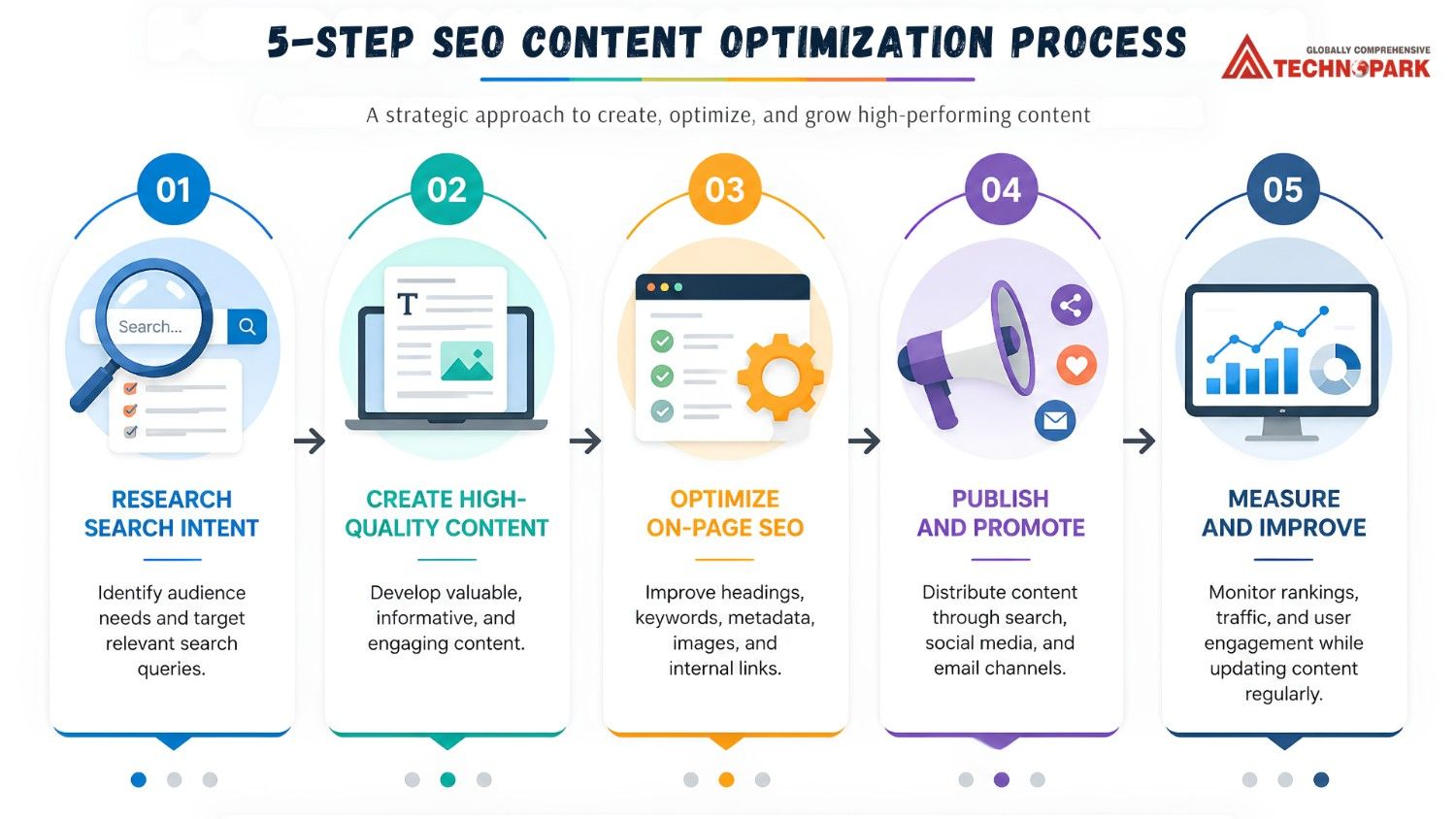
The broader trend across search engines is toward rewarding genuinely helpful content, prioritizing user satisfaction, and better understanding queries through semantic search rather than exact keyword matching alone.
Building Sustainable Organic Traffic Through Better Content
SEO content optimization boosts your search rankings, enhances the visitor experience when they get on your site, generates more qualified leads and provides long-term sustainable business growth. Well-optimized content creates a compounding effect that continues to attract visitors long after you publish it, unlike paid advertising.
Our team of Digital Marketing Solutions will help you develop an SEO content strategy specific to your brand and transform your content into a true engine of organic growth. Boost your SEO today.
FAQ
1. What is SEO content optimization?
SEO content optimization is the art of tweaking website content, its structure, keywords, formatting, etc. such that it ranks well in search engines while still being useful and readable for real people.
2. How does SEO content optimization improve website traffic?
Improved content enhances the results of search engines, increases click rates as well as registration of visitors to a website and helps to improve the quality of users appearing through an organic search.
3. How often should you update SEO content?
Review most content annually. Update important or rapidly changing topics more frequently to ensure they remain accurate, relevant, and effective.
4. Why is search intent important in SEO?
Content that doesn’t match searchers’ genuine search intent rarely performs highly, no matter how technically optimized it is. Matching search intent means the material actually serves the demands of your audience.
5. Can SEO content optimization improve conversions?
Optimized content can also help you drive more relevant traffic to your site – those visitors that are ahead of the competition in the decision-making process. This means higher-quality leads and greater conversion rates than unoptimized material that draws less focused traffic.